

Sugar-Free Iced Coffee and Calories: What’s Really in Your Cup?
Two iced coffees can look almost identical and still have very different nutritional values. The difference often comes from the milk, sugar, syrups and portion size rather than the coffee itself. Here is how to read the numbers without turning every cup into a calculation.
Iced coffee can be one of the simplest drinks you make, or one of the most elaborate. One glass may contain coffee, water and ice. Another may include milk, sugar, flavoured syrup, cream or other additions. That is why the calories in iced coffee cannot be judged from the name of the drink alone.
The same applies to sugar free iced coffee. Removing sugar does not automatically make every version nutritionally identical. The final numbers still depend on what else goes into the glass and how much of each ingredient is used.
Why there is no single calorie number for iced coffee
Coffee prepared with water and ice is very different from a large milk-based iced coffee with syrup, even though both may simply be described as iced coffee.
To understand what is actually in your cup, it helps to break the drink into parts: the coffee base, the liquid used to prepare it, any added sweetener or sugar, and any syrups or toppings.
The name “iced coffee” does not determine its nutritional value. The ingredients, quantities and serving size do.
Milk can change the whole drink
When iced coffee is prepared with water, the calculation is relatively simple. Once milk is added, the nutritional values of that milk become part of the finished drink.
Milk naturally contains lactose, which is a milk sugar. This means a coffee made with milk can contain sugars even when no table sugar has been added.
Fat, carbohydrates, protein and calories also vary between different types of milk. The same applies to plant-based drinks. Some are unsweetened, while others contain added sugars or have a higher energy value.
So when comparing sugar free iced coffee made with water and the same drink made with milk, the coffee mix may be unchanged, but the final cup is not.
What happens when sugar is added?
Added sugar becomes part of the drink and contributes to its overall nutritional value. At home, this is easy to track because you know whether you added one teaspoon, two or none at all.
With bottled coffee or a drink prepared outside the home, the amount may not be obvious from appearance or taste. The nutrition information and ingredient list are much more useful than guessing.
This is also why a low sugar iced coffee is not automatically the same thing as an iced coffee with no sugar. “Low sugar” and “sugar free” describe different situations, so the actual values on the label matter.
Syrups are part of the recipe too
Vanilla, caramel, hazelnut and other flavours are common in iced coffee, but the flavour name alone does not tell you what is in the syrup.
A regular syrup may contain sugar. A sugar-free version may use a different sweetening system. In both cases, the quantity added to the cup affects the final drink.
This is why two glasses of sugar free iced coffee can still have different calorie values if one contains only coffee and water while the other includes milk or additional ingredients.
Ready-made iced coffee versus making it yourself
Ready-to-drink coffee is convenient, but its recipe is already fixed. Depending on the product, it may contain milk, sugar, flavourings or other ingredients.
Making iced coffee yourself gives you more control over the final cup. You can choose water or milk, decide how much to use and see exactly what has been added.
- Coffee with water and ice. A simple composition that is easy to understand.
- Coffee with milk. The nutritional values of the milk become part of the drink.
- Coffee with a plant-based drink. Check the specific product, because formulations vary.
- Coffee with sugar. Added sugar contributes to the final nutritional values.
- Coffee with syrup. Both the syrup type and the amount used matter.
Does sugar free mean zero calories?
No. These are two different claims. A drink can contain 0 g of sugar and still have a small number of calories from other ingredients.
This distinction is useful because searches for zero calorie iced coffee and sugar free iced coffee are not asking exactly the same question. Sugar content and energy value should be checked separately.
A practical example: INSTICK Iced Coffee
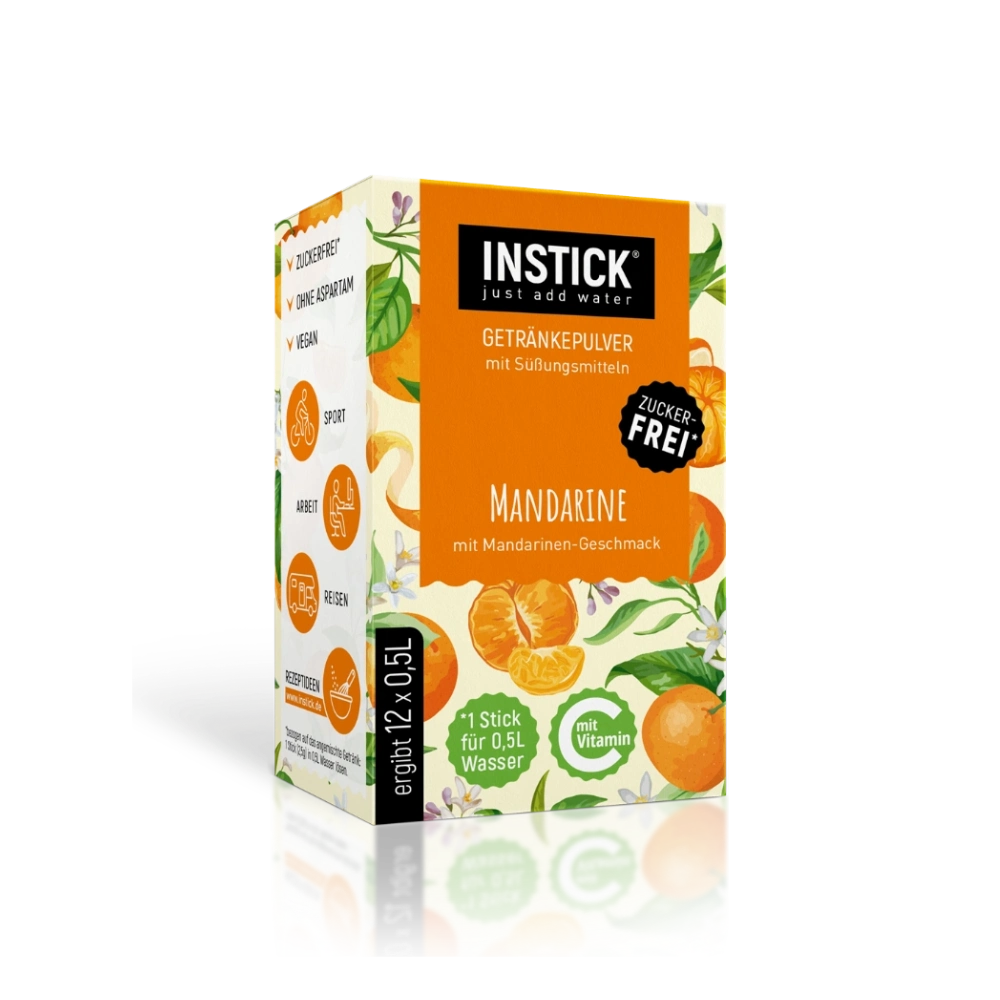
INSTICK Iced Coffee contains 80% soluble coffee made from coffee beans. The ingredient list also includes flavouring, maltodextrin, gum arabic as a stabiliser, sucralose as a sweetener and L-ascorbic acid, which is vitamin C.
One stick contains 2 g of powder and is intended for 250 ml of drink. When prepared with water according to the instructions, the finished drink contains 2 kcal and 0 g of sugar per 100 ml.
That means one 250 ml glass prepared with water contains 5 kcal and 0 g of sugar.
This makes the product a useful example of how sugar free iced coffee should be read: first look at the ingredients, then check the nutrition information and finally make sure you understand which preparation method the values refer to.
What changes if you prepare it with milk?
The coffee powder itself stays the same. What changes is the liquid used to prepare the drink.
If you use milk instead of water, the calories, carbohydrates, natural sugars, protein and fat from that milk become part of the finished coffee. The final values therefore depend on the type of milk and the amount used.
The 5 kcal figure for one 250 ml serving applies to preparation with water. A milk-based version should be calculated using the nutritional information of the milk you choose.
The same principle applies to a plant-based drink. There is no universal number because different products have different formulations.
What does “healthy iced coffee” actually tell you?
The phrase healthy iced coffee is very broad. A single word cannot tell you the serving size, amount of sugar, type of milk or full ingredient list.
A more useful approach is to look at the specific information that matters to you. You may want to reduce added sugar, choose a lighter drink, use a particular type of milk or simply understand the ingredients better.
There is no need to turn iced coffee into a nutritional test. The point is simply to know what makes one version different from another.
How to estimate your cup in a few steps
- Check the volume. Start with the actual size of the glass.
- Identify the base. Water, milk or a plant-based drink.
- Check the quantity of milk. Use the nutrition label of the product you actually poured.
- Include sugar and syrups. If they are in the drink, they are part of the calculation.
- Include other additions. Cream, sauces and toppings also contribute to the final values.
This approach is much more useful than looking for one universal number for every sugar free iced coffee.
Is fewer calories always the better choice?
Not necessarily. Calories are one piece of information, not a complete description of a drink.
It can also be useful to look at the sugar content, serving size, ingredient list and preparation method. One person may prefer coffee with milk for its taste, while another may prefer an iced coffee no sugar version prepared with water.
Neither choice needs to be treated as a rule for everyone. The value of reading the label is that it lets you understand the difference and choose deliberately.
The bottom line
Sugar free iced coffee can be very simple or quite different depending on how it is prepared. Water, milk, plant-based drinks, syrups and other ingredients all affect the final nutritional values.
INSTICK Iced Coffee prepared with 250 ml of water contains 5 kcal and 0 g of sugar. If you prefer it with milk or a plant-based drink, simply add the nutritional values of the base you choose. That way you can prepare the coffee the way you like it and still know exactly what is in your cup.
Maya Levi
Content editor at INSTICK Israel. Writes about nutrition in plain language, without jargon or lectures. Mom of two who keep trying to steal her sticks.
All Articles by Maya Levi ←