

How Much Sugar Is Really in Your Drinks?
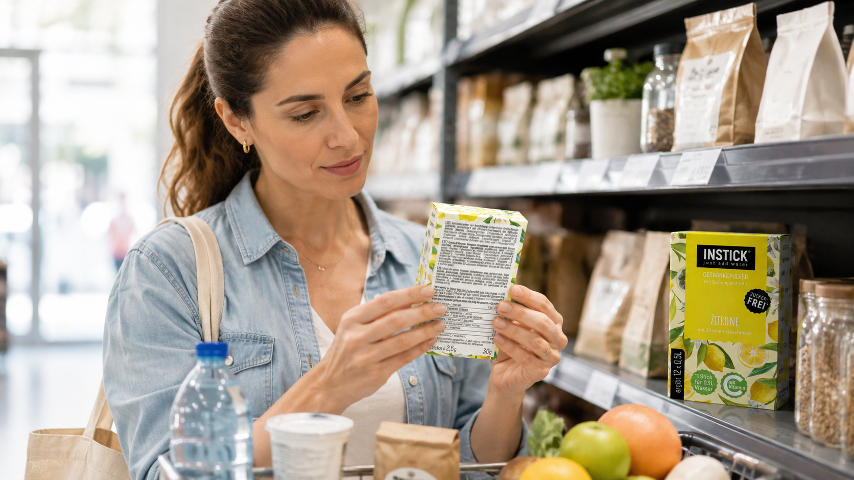
Sugar in drinks is easy to overlook because it is already dissolved. A quick look at the nutrition label can tell you how much is actually in the bottle, while the ingredient list explains where the sweetness comes from.
When we think about sugar, it is easy to picture a spoonful added to coffee or a piece of cake. Sugar in a drink is less visible because it is already dissolved. A bottle can look light and refreshing while still containing a substantial amount of sugar, which is why the nutrition label is much more useful than trying to judge a drink by appearance or taste.
Understanding sugar in drinks does not require complicated calculations. Start with the amount of sugars per 100 ml, check the size of the bottle or glass, and then look at the ingredient list to see where that sugar comes from.
How much sugar can be in one bottle?
There is no single number for every soft drink, because recipes differ. A useful real-world example is Coca-Cola Original Taste. According to Coca-Cola’s official nutrition information, it contains 10.6 g of sugar per 100 ml. A 500 ml bottle therefore contains 53 g of sugar.
Using the World Health Organization’s approximate conversion of 25 g of sugar to around six teaspoons, 53 g works out to roughly 13 teaspoons. This example should not be treated as an average for every soft drink, but it shows why checking the actual label matters.
Source: Coca-Cola Original Taste official nutrition information. Sugar content: 10.6 g per 100 ml.
What does the WHO actually recommend?
The World Health Organization recommends that adults and children keep free sugars below 10% of total daily energy intake. WHO also suggests that reducing free sugars further, to below 5% of total energy intake, may provide additional health benefits. For a person consuming about 2,000 kcal per day, that 5% level is approximately 25 g, or around six teaspoons.
It is important to describe this correctly. The 25 g figure is not a universal daily maximum for every person. It represents the WHO’s more ambitious 5% level, while the recommendation to stay below 10% of total energy intake is the primary recommendation.
Source: World Health Organization, Guideline: Sugars Intake for Adults and Children.
A label gives you more useful information than sweetness alone. Two drinks can taste equally sweet while containing very different amounts of sugar.
What are free sugars?
The WHO uses the term “free sugars” for sugars added to foods and drinks by manufacturers, cooks or consumers, as well as sugars naturally present in honey, syrups, fruit juices and fruit juice concentrates.
This distinction is useful when looking at sugar in drinks. A regular soft drink may contain added sugar, while fruit juice contains sugars that come from fruit but are still included in the WHO definition of free sugars.
Whole fruit is treated differently because the sugars remain within the natural structure of the food. This is one reason the ingredient itself and the way it is consumed matter when interpreting a label.
Why drinks deserve a closer look
Drinks can contribute a meaningful amount of sugar without making that quantity visually obvious. Unlike sugar added with a spoon, the sugar in a bottled drink has already disappeared into the liquid.
The U.S. Centers for Disease Control and Prevention identifies sugar-sweetened beverages as a leading source of added sugars in the American diet. This category includes regular soft drinks, fruit drinks, sports drinks, energy drinks, sweetened waters and some flavoured coffee drinks.
Source: U.S. Centers for Disease Control and Prevention, Sugar-Sweetened Beverage Consumption.
How to check sugar in a drink in seconds
You do not need to memorise the sugar content of every drink. Use the same quick check each time.
- Find the sugars line. Check how many grams are listed.
- Check the reference quantity. Is the value given per 100 ml or per serving?
- Look at the bottle size. A 500 ml bottle contains five times the amount listed per 100 ml.
- Read the ingredients. This shows whether sweetness comes from sugar, juice, syrup or sweeteners.
- Compare like with like. Use the same volume when comparing two drinks.
This simple method gives a much clearer picture of sugar in drinks than words such as “refreshing,” “fruit flavour” or “light” on the front of a package.
Does a sweet drink always contain sugar?
No. Sweet taste and sugar content are not the same thing. A drink can use high-intensity sweeteners to create sweetness while containing 0 g of sugar.
Sucralose and acesulfame K are two examples. Because they are much sweeter than ordinary table sugar, only small amounts are needed in a formulation.
This is why the amount of sugar in drinks cannot be estimated by taste. A sweet sugar-free drink and a sugar-sweetened drink may both taste sweet, but their ingredient lists and nutrition tables can be very different.
A practical example: INSTICK Fruit Punch
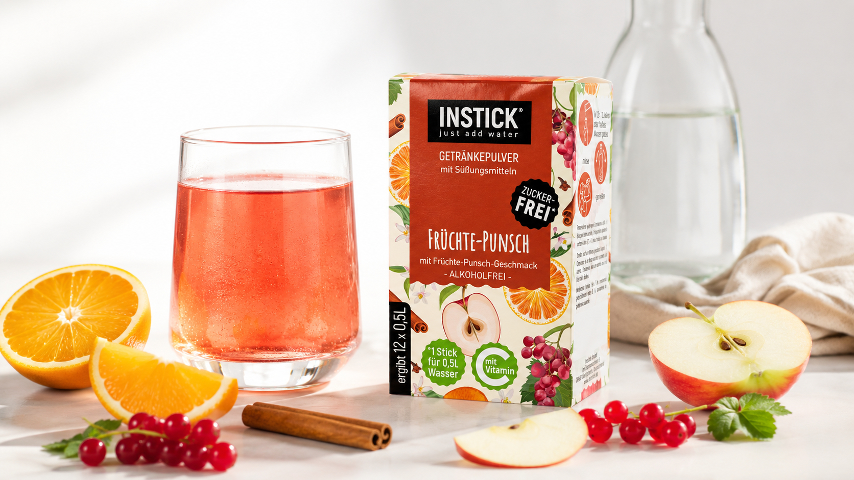
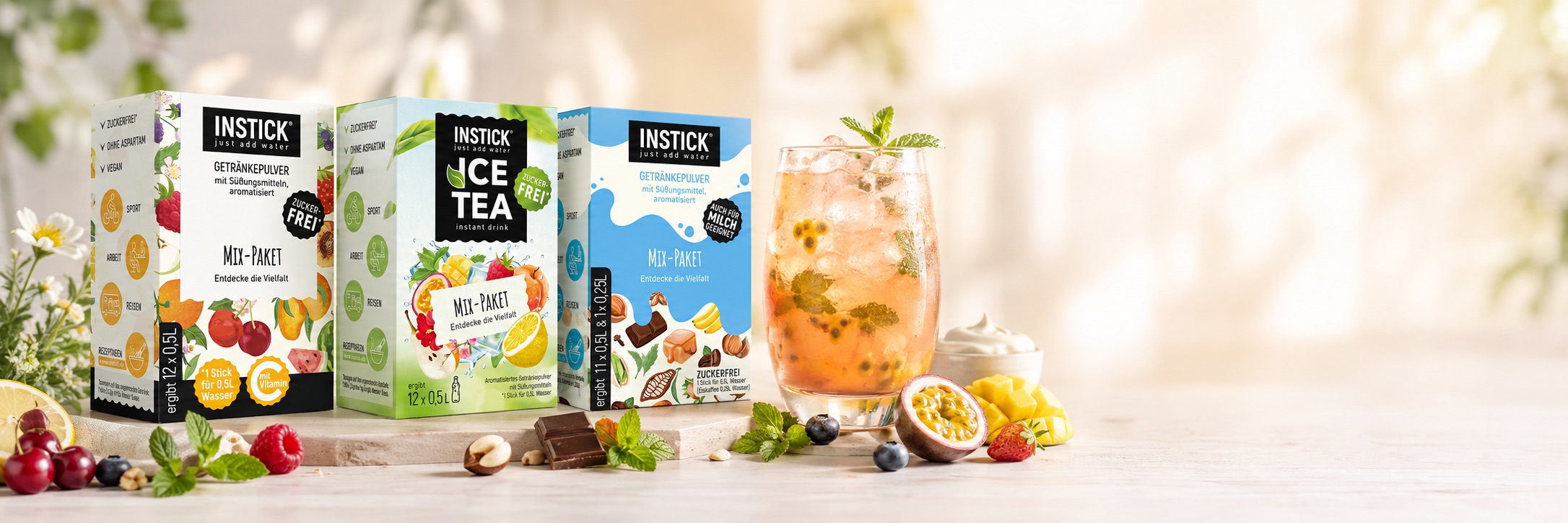
INSTICK Fruit Punch is a sugar-free drink mix sweetened with sucralose and acesulfame K. The ingredient list also includes citric acid, malic acid, maltodextrin, natural flavours, gum arabic as a stabiliser, colouring food ingredients from black carrot and safflower, and L-ascorbic acid, which is vitamin C.
One stick contains 2.5 g of powder and is designed to prepare 0.5 litres of drink with water. The prepared drink contains 2 kcal and 0 g of sugar per 100 ml. The full 500 ml prepared drink therefore contains 10 kcal and 0 g of sugar.
The important point is not simply that the drink tastes sweet. It is that the label shows where the sweetness comes from and confirms how much sugar is present in the prepared drink.
Sugar-free does not mean flavour-free
Reducing sugar in beverages does not necessarily mean replacing every flavoured drink with plain water. There are different ways to make a drink taste sweet, and the label allows you to see which approach a particular product uses.
If your goal is to pay more attention to sugar in drinks, the easiest place to start is with the beverages you already consume regularly. Check the drinks in your refrigerator, the coffee you buy on the way to work and the bottles you usually choose at the supermarket.
Once you know what is in those few regular choices, there is no need to analyse every drink from scratch.
What about juice?
Juice can create some confusion because its sugars originate in fruit rather than being necessarily added as table sugar. Under the WHO definition, however, sugars naturally present in fruit juice and fruit juice concentrates are included within free sugars.
That does not make juice identical to a regular soft drink. Their ingredients and nutritional profiles can be different. It simply means that when you are looking specifically at free sugar intake, juice also needs to be counted.
Five useful habits when choosing a drink
- Read the sugars line first. It gives you an actual number to work with.
- Pay attention to volume. Values per 100 ml can look small until multiplied by a large bottle.
- Check the ingredient list. It explains what creates the sweetness.
- Do not judge by taste alone. Sweet does not automatically mean sugar.
- Compare realistic portions. Compare the amount you actually expect to drink.
The bottom line
The easiest way to understand sugar in drinks is to stop guessing and start with the label. A specific 500 ml regular soft drink can contain more than 50 g of sugar, while another sweet-tasting drink can contain 0 g because its sweetness comes from other ingredients.
You do not need to turn every drink into a nutritional calculation. Check the sugars, check the volume and read the ingredients. Those few details are enough to understand what is really in your glass and make a choice based on facts rather than assumptions.
Maya Levi
Content editor at INSTICK Israel. Writes about nutrition in plain language, without jargon or lectures. Mom of two who keep trying to steal her sticks.
All Articles by Maya Levi ←